december 9 2025
For this last lesson of the year, the audience braved the harsh winter weather and tried to warm up the atmosphere with some lively variations.
The warm-up began with a pawn endgame with, as usual, a few subtleties that should have led to a draw, but that was without counting on the temperament of young Bobby, for whom a draw was not an option and who ended up losing.
The exercises continued with a very fine Beasley, a no less fine Minski, and to conclude, an excellent Guy, to whom we pay tribute for his creativity.
For the game of the day, a beautiful battle with a face-to-face between Anand and Karpov, in which the audience was able to let loose on the variations in which the material deficit counts for little!
The fairy that followed brought us some beautiful compositions, always carefully selected by the Master.
Happy reading to all and see you in 2026.
Master's word
« Saying what I think about "humanity" in general is quite easy for me: I don't hold "humanity" in high regard; I think that the world is, a priori, made up of 95% of people who are completely uninteresting, incapable of the slightest personal reflection, driven by their impulses and desires, easily manipulated by anyone... The omnipresence of television has not helped matters. As a great writer once said, "alcoholism, gossip and politics have created enough idiots to make television necessary". What is more difficult in a short space of time (I am writing these lines in the middle of a Year 9 exam) is to explain why we can, and must, keep our spirits up and love life passionately despite everything. The fact is that among the remaining 5% there are enough geniuses, or simply healthy people (in body and mind, as they used to say), to make life beautiful. Someone once said that we remain young as long as we retain the ability to admire. But we must have developed this ability while we were young. And to develop it, we must know that there is something to admire (a great deal, in fact) and find it. This ability is not only an elixir of youth but the very raison d'être of existence, whatever our age. Beauty (immense beauty) exists in as many different areas as possible (and the time we spend on earth is ridiculously short to hope to take stock of it all). As far as I'm concerned, I discover new wonders every day. Seeing people's faces (I dare not say "mugs") on the underground (which I use as little as possible) shows me abundantly that this is not the case for them...". Text written by your "master" on 4-5-2000 at school, as already mentioned, and communicated to his pupils the following day. A quarter of a century later, I don't see a single word that needs changing. All that needs adding is: "television, mobile phones, the internet".
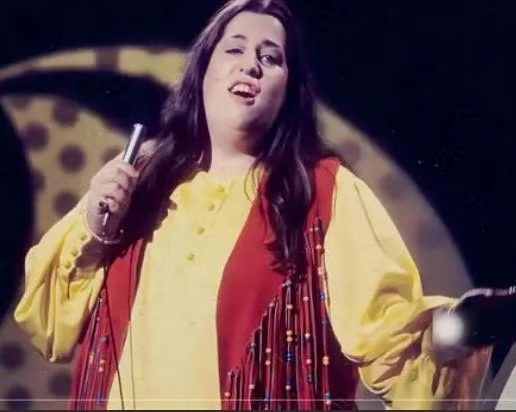 "We must communicate a taste for beautiful things, beauty, work, deep values... I have never seen a criminal come out of my music schools." (Y. Menuhin).
"The darkest hour is just before dawn". Dedicated to all course listeners ! https://youtu.be/zUr5_QVPCAI
"From the day I realised who the people were that I annoyed, I did everything I could to annoy them." (S. Guitry). 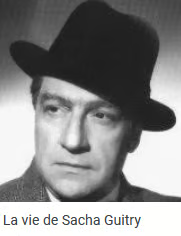
"We should have the courage, from time to time, to cheat on pretty women with women who are no longer young and who might be ugly. That would teach them a lesson about life." (S. Guitry).
"The English killed Joan of Arc. Today, she is killed at school." (P. Guth).
 "I have never been convinced of the existence of God, but I am absolutely convinced of the existence of the Devil." (M. Bock-Côté).
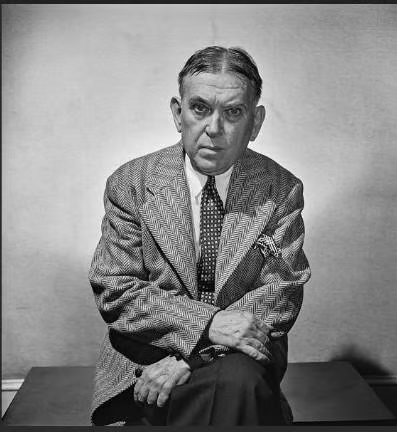
"Bigamy consists of having one wife too many. So does monogamy." (H. L. Mencken).
"What attracts me to chess is not the rules, but their exceptions, which, fortunately, are very common." (V. Kortchnoï).
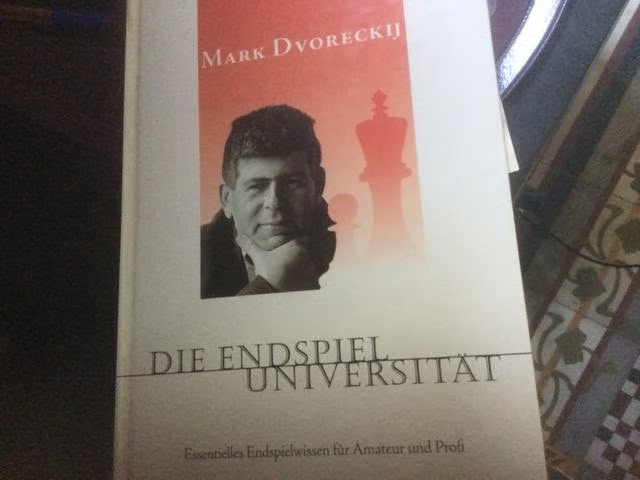 Endgame books: the scientific approach consists of reporting discoveries in chronological order. This was the approach taken by the Russian author (MD) who died in 2016. The anti-scientific approach, adopted by an English author, a German author and many others, consists of giving preference to the most recent, practising total amnesia regarding the heritage. Furthermore, these same questionable authors neglect pedagogy by misusing databases, giving preference to the first moves displayed by the machine rather than those that are most understandable. And they neglect dignity, shamelessly attributing cybernetic discoveries to themselves.
A light-hearted endgames to this lesson: a 16-year-old Bobby wreaks havoc in a pawn endgame, with an unexpected reciprocal zugzwang (ZZ) after a surprising defence. Another ZZ follows shortly afterwards, introduced by a white move on the same square as the aforementioned defence. Yet another ZZ occurs on the 48th move.
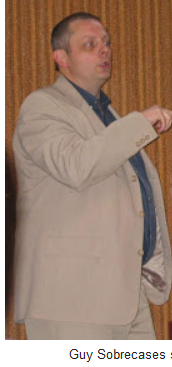 A very easy exercise from the late editor of BESN ("british endgame study news"), A charming study by Martin where White has a Bishop surplus. Finally, our friend Guy shows us 3 ZZ with a pawn on c3, c4 and c5 respectively !
For the next lesson, a difficult bishop endgame with brilliant pawn moves, a bishop versus knight struggle with a sub-promotion, and finally a little play with heavy pieces.
 The game is monstrous. The white player is fired up by a defeat the day before. A good reaction: our kids should follow this example! The bishop sacrifice is entirely correct, but demonstrating the advantage over any defence is sometimes very difficult. Many brilliant moves, some shown by the monster, but most... by humans!
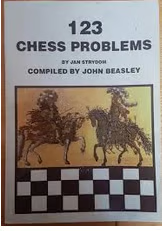
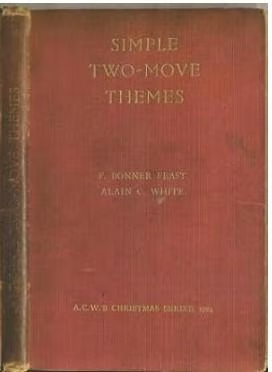 Training: the 2# are easy, except perhaps the 2nd, 5th, 6th (appreciate the twin), 9th and 11th. Continuing the tribute to the brilliant Strydom: in these 3#, we could "do nothing", but there are no neutral moves, so we have to change all or part of what has been prepared. We leave the solution to the last two. An easy helpmate and 3 selfmates, including a long one that is fully explained.
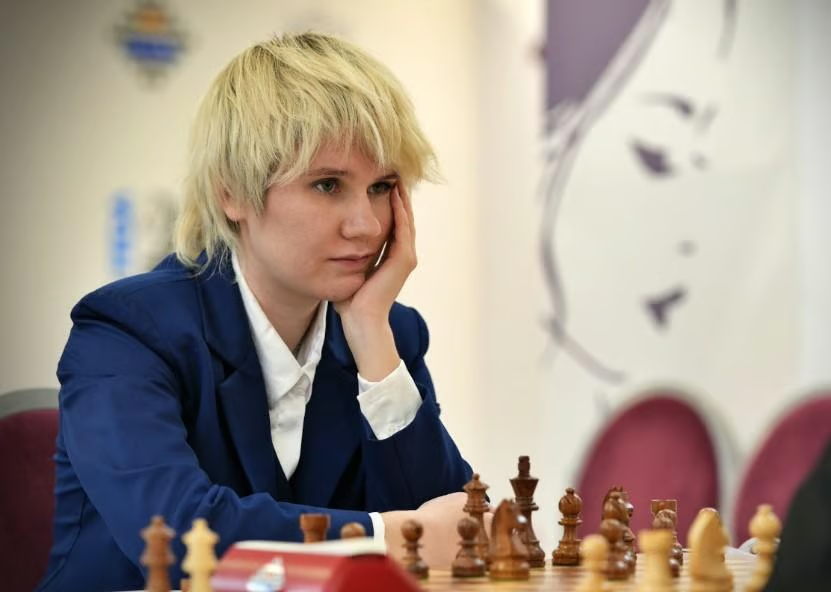
News: Russia crushed the Women's World Team Championship, thanks in particular to the divine Polina Shuvalova, who scored 9.5 points out of 10 games. Also worth noting is the strong performance of our Anna, a living refutation of all the French idiots: the more chess problems she solves, the better she plays chess!
Have fun and Merry Christmas. As my friend Van Morrison said in the last lesson, "didn't I come to bring you a sense of wonder ?".
Semoga Tuhan memberkati Anda. Hari Om. Да благословит вас Бог.
Comments
1 Alain On 25/12/2025
Thank you for these incredibly precise details. Of course I am interested in these documents. At present, I am far too busy to study them properly. I suggest you contact the website (at the top right of your screen). That way, I can get your email address and you can get mine!
Շնորհավոր Սուրբ Ծնունդ
2 Vardan Poghosyan On 22/12/2025
Many thanks for your kind reply and for the clarification. I now fully understand your concerns.
Unfortunately, the Roycroft edition omits an important warning by Kasparyan that appears in both Russian editions of his studies (1972, p. 59, and 1988, p. 52). There Kasparyan explicitly notes that a proper understanding of his study is facilitated by reading his article “Rook and Two Connected Pawns versus a Rook” (Shakhmaty v SSSR, nos. 4 and 5, 1946).
Incidentally, both German editions of his studies (Zauber des Endspiels, 1974, p. 46; 1985, p. 46), as well as the Spanish edition (Finales artísticos, 1976, p. 69), do include a reference to this article. Moreover, Kasparyan reproduced the article in full in the 1988 edition of his studies (pp. 249–260).
This substantial article—submitted by Kasparyan to Shakhmaty v SSSR as early as 1940 but published only after World War II (the magazine was not issued between 1941 and 1945)—covers all relevant pairings (rook–knight, bishop–knight, bishop–king, and central pawn couples). In it, Kasparyan analyses in detail all critical lines of his study, including the line 1…Rd3. Dvoretsky later incorporated most of this analysis into his Endgame Manual.
If you are interested, I would be happy to send you scans of the original article from Shakhmaty v SSSR as well as the relevant pages from the book edition.
You are also entirely right regarding the 1984 edition of Averbakh. I have compared it with the 1958 edition authored solely by Kopayev and found that Averbakh essentially reproduced the 1958 analysis without modification. It should be noted, however, that the 1984 edition is formally a joint work by Averbakh and Kopayev—the latter’s name appears in the title of Rook Endings. In 1958, Averbakh acted only as the editor of the volume, while following Kopayev’s death in 1978 he became a co-author of the 1984 edition.
With kind regards,
Vardan Poghosyan
3 Alain On 21/12/2025
4 Alain On 21/12/2025
I know your name, especially for your fine findings in the ending R+4P / R+3P with a passed pawn on the "a" file.
The sentence you quote was written in 1981 but is still valid. I don't have some old russian books anymore but in "the complete studies of Kasparyan" (J. Roycroft 1997) the analysis of this masterpiece (p. 56-58) seems really too short to me. Similarly in the 1984 book (физкультура и спорт) signed by Averbakh but certainly written by Kopaiev p. 179-180.
A new analysis with modern engines (and of my exercise 231, strongly connected to this study) remains to be done.
Many thanks for your interest in my work and happy Christmas. Greetings.
5 Vardan Poghosyan On 21/12/2025
My name is Vardan Poghosyan, I am a passionate fan of rook endgames, maybe my name is known to you from Dvoretsky's textbook or from the ChessPub website, where I publish my analyses.
I have a question regarding Kasparian’s etude in your book Les Finales, Tome 1 (Grasset, 1998, pp. 244–246). You mention that:
"Les analyses précédemment publiées sur cette passionnante étude sont notoirement insuffisantes, y compris dans les livres de Kasparian lui-même, et parfois contradictoires !"
Could you clarify where you see these insufficiencies and contradictions? Even a brief explanation would be greatly appreciated.
Wishing you a Merry Christmas and all the best,
Yours sincerely
Vardan Poghosyan
Add a comment